|
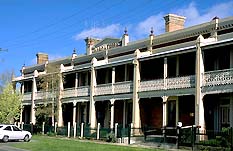
| Cambria Terrace, a fine
collection of terrace houses, Bathurst,
|
Bathurst
Major historic city on the western side of the Great
Dividing Range.
Bathurst is located on the Macquarie River 207 km west of
Sydney via the Great Western Highway and 670 m above
sea-level. Australia's oldest inland city, it has many fine
historic buildings.
With a population of 30 663 Bathurst is one of
Australia's fastest-growing regional centres. The raising of
sheep, cattle and horses, which began with the earliest
European occupation of the land, is still practised on large
land holdings near the city. However, education is now the
largest single industry. Other contributions to the local
economy are made by fruit and vegetable production, a
vegetable cannery, a fish processing plant, a pet food
processing plant, and government and community services.
Gregory Blaxland, William Wentworth and William Lawson
became the first Europeans to find a way across the Blue
Mountains in May 1813 which resulted in settlement beyond
the Cumberland Plains. However, it was surveyor George Evans
who crossed the main range later that year. During the trek
he camped on the future townsite of Bathurst and made a
favourable report of the country he saw. Evans named the
Macquarie River after Governor Lachlan Macquarie and the
Bathurst Plains after Lord Bathurst, the British secretary
of state for the colonies.
By January 1815 William Cox had completed the
considerable feat of building a road over the mountains and
in April Governor Macquarie traversed this new route. When
he reached the road-building party's depot on the west bank
of the Macquarie River he proclaimed it 'a site for the
erection of a town at some future period' which was to be
named Bathurst. Later that year a government domain,
consisting solely of troopers, government personnel and
convict labourers, was established. Surrounded by a large
government stock reserve, it was used as the launching pad
for explorations of the interior by Evans in 1815, John
Oxley in 1816, Allan Cunningham in 1823 and Charles Sturt in
1828.
Private settlement was forbidden on the west bank but
Governor Macquarie decided to issue ten 50-acre allotments
on the east bank to small landholders in the hope that they
would be able to supplement the colony's food supplies. To
this end ten 'sober and industrious' grantees were given a
cow, a servant and four bushels of wheat seed. However, the
problematic nature of transport over the difficult Sydney
road negated such efforts.
Although it was initially known as Bathurst, the
settlement on the east bank had, by the early 1820s, become
known as Kelso (now an outer suburb of Bathurst). The Dun
Cow Inn opened there c.1817 and the Anglican Church
established a parish in 1825.
At the time the area was occupied by the Wiradjuri
people, the largest Aboriginal group in NSW, who initially
believed the white newcomers to be the spirits of dead
kooris. The conflict which followed became so severe that
Governor Brisbane declared a state of martial law in 1824
and despatched troops to Bathurst. Reprisals ensued and the
Aborigines were slaughtered without regard for age or sex.
After four months and 120 deaths (perhaps one-quarter of the
Wiradjuri people) the tribe came down from the hills to call
for a truce.
A rebellion of 80 convicts was quelled in 1829 after one
of their number was flogged for swimming in the purview of
Governor Darling and his retinue.
In 1832 Thomas Mitchell discovered the Victoria Pass and
a much improved route across the mountains was quickly
established. Consequently Governor Bourke decided to open up
the government reserve at Bathurst to the public. It was
surveyed and land sales proceeded in 1833. This new
settlement soon became the centre of a major pastoral area
and a regular coach service from Sydney had been established
by 1835.
The depression of the 1840s forestalled expansion but, in
1851, the first payable gold in the country was found at
nearby
Ophir. This sparked a remarkable gold rush which
transformed the entire colony. Due to its location and its
early establishment Bathurst was greatly affected. It became
a commercial centre for those en route to the diggings and
the town's population doubled in the course of the 1850s to
over 4000. There were some 50 grog shops in operation by
1860. Two years later Bathurst became a municipality. That
same year the Cobb & Co coach company expanded its
operations from Victoria to NSW, making Bathurst its
headquarters.
Notorious bushranger Ben Hall was married in St Michael's
Church at Bathurst in 1856. In October 1863 Hall, with John
Gilbert, Michael Bourke, John O'Meally and John Vane
'visited' Bathurst in broad daylight. After robbing a
jeweller's shop in Howick St they bailed up the Sportsman's
Arms Hotel in Piper St and tried to steal a racehorse while
the police rode about in search of them. Shots were
exchanged in George St as they fled.
The gang returned three days later holding up stores,
houses and hotels on the outskirts of town before the police
were alerted and the bushrangers dissolved into the evening.
Near
Rockley they kidnapped the gold commissioner and held
him to ransom. His wife rode to Bathurst in the middle of
the night to obtain ransom money. In the next few weeks
Bourke was killed and, in November 1863, John Vane
surrendered at the Bathurst courthouse.
Another bushranger, John Piesley (see entry on
Binda), was tried and hung for murder at Bathurst gaol
in 1862.
|
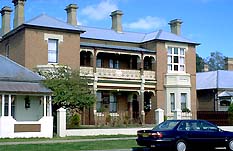
| Strathmore Victorian
Manor (a guest house), 202 Russell Street, Bathurst
built in 1882 |
The railway arrived in 1876, opening up the Central West
to the Sydney produce markets and proving a further boost to
the town's fortunes as a provincial centre. The population
increased from 5000 in 1871 to over 9000 by the end of the
century with Bathurst declared a city in 1885.
By the end of the 19th-century the large wool enterprises
of the district were giving way to smaller holdings with an
emphasis on cattle, agriculture, market gardening and fruit
orchards. The latter enterprise received a boost when
returning soldiers were granted land after World War I,
turning their efforts largely to orchards. Motor racing also
developed in the area from 1911 culminating in the
establishment of the Mt Panorama Racing Circuit in 1938.
A strong emphasis on the retention of local industries,
the development of educational institutions, the
establishment of decentralised government departments and
tourism have been features of the local economy since World
War II.
Ben Chifley, the son of a blacksmith and the prime
minister of Australia from 1945 to 1949, was born at
Bathurst in 1885 and maintained his connections with the
city until the end of his life. He joined the NSW railways
at 17 and, at 26, became the youngest locomotive driver in
the state. Chifley became a union representative in 1913 but
was demoted to cleaner due to his involvement in the Great
Strike of 1917. He entered parliament as the member for
Macquarie (the local seat) in 1928 and became the treasurer
and minister for postwar reconstruction in Curtin's
government. When Curtin died in the last month of World War
II Chifley became prime minister. From 1949 until his death
in 1951 he was leader of the opposition. He was interred at
Bathurst.
April witnesses the Royal Bathurst Show, the Bathurst
Picnic Races and National Trust Heritage Week. The Bathurst
1000 Super Touring Car Race and the Australian 1000 Classic
are held at Mt Panorama in October and the Bathurst Cycle
Classic in November.
Things to see:
Tourist Information
The Bathurst Visitors' Centre is located at 28 William St,
on the Durham St corner, tel: (02) 6332 1444, or ring
toll-free on (1800) 681 000. The centre has an old Cobb & Co
coach on display, a 'Fossicking Guide for Bathurst and
District' and information sheets detailing the picnic areas
in town, a self-drive tour, the courthouse, Machattie Park
and an historical walking tour.
|
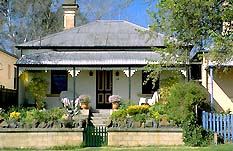
| A fine example of
Bathurst's architecture - Number 14 - a house only
two houses away from Ben Chifley's house
|
Historic Walking Tour
Police Barracks and The First Settlement
Opposite the visitors' centre is the Bathurst Bowling Club.
The current building was erected in 1890 as the police
barracks. When the government domain was established at
Bathurst in 1815 this site was the headquarters of the army.
Some barracks and a gaol were built here in 1822. The town's
first courthouse and magistrate's quarters stood opposite.
Head west along William St. Across Durham St is the
Bathurst Shopping Centre where the first Presbyterian Church
(1835) once stood. Some bricks from the old church and a
commemorative plaque are on the front wall of the shopping
centre. The adjacent allotments were the first in Bathurst
to be sold when the old government reserve was opened to
public sale in 1833.
Howick Street
Turn left into Howick St. On the left-hand side of the road
is a workman's cottage of the 1830s or 1840s. The Howick and
Bentinck St corner features eight detached and semi-detached
19th-century cottages, built of bonded red brick with
continuous verandahs. They are rare surviving examples of
their type.
The Ben Hall Raid
Return to William St and turn left. The allotments at 74 and
76 William St were once the site of Cobb and Co. offices.
When Ben Hall's gang raided the town in 1863 they bailed up
a gunsmith's shop which occupied one of these allotments and
a nearby jeweller's shop. They then visited the Sportsman's
Arms Inn (now the site of the Bathurst Leagues Club), and
attempted to steal a racehorse.
Westpac Bank
This imposing Classical building, with its columned central
porch and arched ground floor, was erected c.1895 for the
City Bank of Sydney. This site was previously occupied by
the Carriers Arms Inn where, in 1851, Edward Hargraves
announced the discovery of the first payable gold in
Australia, thus sparking a national goldrush.
Royal Hotel
This grand old inn dates from the 1840s. The decorative iron
lacework is of a slightly more recent vintage and the whole
has recently been restored. It now contains shops and a
restaurant in the downstairs section with accommodation
available upstairs.
Methodist Complex
The Methodist (now Uniting) Church in William St, opposite
Machattie Park, was built of red bricks with stuccoed
dressings to a Gothic Revival design in 1860. The
copper-covered spire, porch and vestibules were added in
1876. The organ was installed in the early 1870s.
The simple Georgian-style church hall (1837), with its
large rounded windows, was the original Methodist chapel.
Located at 140 William St, it was also used as the town's
first national school from 1858 to 1866 and was altered
c.1903.
The Brooke Moore Centre next door is essentially a
two-storey red-brick house which was built in 1852 as the
second Methodist parsonage (the original was built in 1838).
The fanlights and twelve-paned windows are typical of that
period. The upper storey, added c.1900, features popular
Edwardian trimmings - small-paned window sashes and a
balcony with decorative woodwork.
Keppel Street and Railway Station
Turn left into Keppel St which became an important
commercial area when the railway arrived in 1876. Many
buildings date from around that era and others have been
built to sympathetic designs. Note the two-storey red-brick
home known as 'Locksley' at the corner of Keppel and Seymour
Sts. Another block brings you to the station which was built
to a High Victorian Gothic design with Dutch gables topped
by finials, bay windows and a cast-iron verandah.
Flour Mill
Just near the railway station in Havannah St is Tremain's
Flour Mill. Built in the early 1850s but no longer in use it
is the only survivor of some ten mills that once existed in
this area which was known as Mill Town.
Bathurst Regional Art Gallery
Return along Keppel St. Between Seymour and Bentinck Sts is
the Bathurst Regional Art Gallery which focuses on
Australian art from 1955. There is a particularly strong
Lloyd Rees collection, Australian ceramics from the early
1960s and the artists of Hill End. Many artists have been drawn to the area over
the years, including Rees and Russell Drysdale. Brett
Whiteley boarded at The Scots School at Bathurst as a youth
and continued to frequent the area until his death in 1992.
The gallery is open from 10.00 a.m. to 5.00 p.m. from
Tuesday to Saturday, and from 11.00 a.m. to 2.00 p.m. on
Sundays and public holidays, tel: (02) 6331 6066.
Roman Catholic Cathedral
Return to the corner of Keppel and William Sts where you
will find the Catholic cathedral which opened in 1861. The
main architect was Edward Gell who designed many buildings
in the area from Lithgow to Dubbo.
Catholic Chancery Office
Continue along Keppel St to the George St corner where you
will find the Patrician Brothers Monastery (c.1885), now the
Catholic chancery office. Note the iron lacework.
Bassett House
Turn right into George St. On the left-hand side is a series
of connecting houses. The earliest section is considered
typical of town dwellings in the 1840s.
Webb's Building
A little further along George St, on the same side of the
road, is a building erected for Edmund Webb, member of the
upper house and several times mayor of Bathurst. He started
his store on another site c.1851 and expanded due to the
prosperity of the goldrush era. The first section was built
in 1862 with 1872 extensions.
Machattie Park
Opposite is a fine late 19th-century Victorian country-town
park with a bandstand, a Begonia House (in bloom from
February to Easter), a caretaker's cottage (c.1890), fernery
and lake. Between the ornate Victorian Munro Drinking
Fountain (imported from England in 1891 and named after the
then-mayor) and the corner of George and Russell Sts is a
tree which is home to a family of possums. A plaque in the
park commemorates the visit to Bathurst of Charles Darwin in
1836.
This reserve is situated on the site of the old gaol
which stood here from 1838 to 1888 when it was demolished to
make way for the park which was named after Dr. R.R.
Machattie who served several terms as mayor. He was also the
leader of the group which fought to have the park on this
site.
|
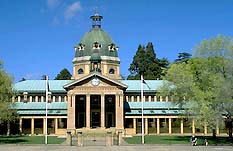
| The Court House
|
Courthouse and Museum
Facing Russell St is the Neo-Classical courthouse with
octagonal Renaissance dome . It is Bathurst's most
distinguished public building and is regarded by the
National Trust as 'one of Australia's finest examples of
Victorian public architecture'. Designed by James Barnet, it
was completed in 1880. The wings, built as the postal and
telegraph offices, were opened in 1877. The entire structure
is 81 m long and 45 m wide.
Donald Horne, author of The Lucky Country, described the
building as 'one of the most successful expressions of late
colonial self-confidence ever produced. Large and, with
forecourt, wasteful enough to belong to the governor of a
prosperous province, it has achieved bland certainty by
overcoming its own complexities - which include a Doric
portico with pediment, an octagonal tower with turret, stone
facings and brick pilasters, a colonnade of Doric pillars, a
sage-green roof, red bricks, yellow bricks and long lines of
sash windows'.
The west wing is now occupied by the Central Western
Music Centre. The east wing is now the Historical Society
Museum. Its collection includes Aboriginal artefacts and it
is open from 10.00 a.m. to 4.00 p.m. on Tuesdays, Wednesdays
and Sundays and from 9.30 a.m. to 4.30 p.m. on Saturdays,
tel: (02) 6332 4755. There is an entry fee.
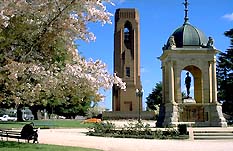
|
| The war memorial
|
Kings Parade
The strip squeezed between Russell and Church Sts is Kings
Parade, situated on the site of the old market place which
was demolished in 1912.
The Bathurst War Memorial Carillon is a 30.5-metre tower
which sits on 12-metre foundations and houses 35 bells. It
was built in 1933 to honour those from the district who
served in World War I. With a repertoire of 40 tunes it
operates at noon and 1.00 p.m. daily.
The Boer War Memorial was unveiled in 1910 by Lord
Kitchener who commanded British troops in India and became
Commander in Chief at the Boer War in South Africa. It
features the name of Lieutenant Peter Handcock who, with
Harry 'Breaker' Morant, was shot by a British firing squad
in South Africa for executing prisoners.
The Evans memorial (1913-1920) commemorates the discovery
of the Bathurst Plains in 1813 by George Evans, Assistant
Surveyor of Lands. The Anglican cathedral was completed in
1971.
Ribbon Gang Lane
In 1829 a young ticket-of-leave convict named Ralph
Entwistle was seen swimming naked in the Macquarie River by
Governor Darling and his retinue. For this affront he was
flogged and his ticket-of-leave removed. This injustice
caused a rebellion of some 80 convicts in 1830. Entwistle
and others became bushrangers, committing robbery and
murder. They were known as the 'Ribbon Gang' after the
ribbons they wore in their hair. Ten of their number,
including Entwistle, were caught at
Abercrombie Caves and hanged at this spot. Ribbon Gang
Lane is situated near the corner of Church and William Sts.
Technical College
The technical college at 79-81 William St is a two-storey
American Romanesque building erected c.1896 of red brick
with terracotta facings and other detailing. The interior is
also of a high quality. The architect was W.G. Kemp. The
section at 79 William St is a former bank and annex to the
school of arts which once existed next door at the Howick St
corner.
Old Public School
Around the corner in Howick St are the former public school
and headmaster's house which were built to G.A. Mansfield's
Gothic Revival design in 1876. One of the first district
schools to be established in the area, it is a red-brick
structure with sandstone base and detailing, a pyramid tower
with lead spire and a gabled slate roof with bargeboards.
The residence has dormer windows, filigree timber
bargeboards and timber verandah. The first telegraph office
(1861) was formerly in front of the residence.
Presbyterian Church
At the corner of Howick and George Sts is St Stephen's
Presbyterian Church, a Gothic structure built of red bricks
in 1871-72.
1 George St
Proceed to the end of George St. At no. 1 is a fine,
two-storey residence built in 1860 for John Ford, a local
banker and coach proprietor.
Old Government Cottage
At the rear of No. 1 George St is Old Government Cottage, a
single-storey sandstock brick Georgian house with a gabled
shingle roof and external bread oven. Built between 1817 and
1820 to house the commandant of the original government
settlement, it is the oldest brick building west of the
Macquarie River. Governor Macquarie also stayed here with
his entourage on his farewell visit to Bathurst in 1821.
This was the site of the government depot set up by
Surveyor Cox during the construction of the road from
Penrith in 1814-1815. The apricot tree outside the house is
thought to have been planted by noted botanist and explorer
Allan Cunningham. Inside, three rooms have been restored to
their original condition with local donations of furniture
and artefacts of the colonial era. It is open on Sundays
from 1.30 p.m. to 3.30 p.m. or at other times by
arrangement, tel: (02) 6332 4755.
Foundation Cairn
Nearby in Stanley St is a cairn to denote the site where, on
7 May, 1815, Governor Macquarie proclaimed the town of
Bathurst. The first church service west of the Blue
Mountains was held near this site on the same day. The
Heritage Wall commemorates the early European settlers of
the district.
Bicentennial Park
Behind Stanley St is Macquarie River Bicentennial Park which
has the best childrens' play equipment in town, cycleways
and a stone weir.
Self-Drive Tour
A number of fine historic buildings fall outside the above
walk but they are included in the Self-Drive Tour, available
from the Visitors' Centre. It takes in historic homes such
as 'Delaware', 'Bradwardine', 'Esrom House', 'Ermington
Park', 'Walmer', 'Llanarth' and 'Eglinton Cottage'. Some of
the highlights are listed below.
Mrs Traill's House and Garden
Miss Traill's House (c.1845) is a colonial Georgian home at
the corner of Russell and Peel Sts which was bequeathed to
the National Trust by the Lee family who were amongst the
very first European settlers to the west. The house, horse
paddock, gardens and domestic collection provide a window
into the past. Items include a convict-painted portrait of
Emily Kite. It is open from 10.00 a.m. to 3.00 p.m. from
Friday to Sunday, tel: (02) 6332 4232. There is an entry
fee.
Nearby in Mitre St is the facade of the carefully
restored Bathurst Hospital (1880s).
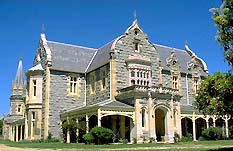
|
| Abercrombie House
|
Abercrombie House and Strath
If you start at the corner of George St and follow Durham St
(Ophir Rd) out of town then, after 7.5 km, you will see, on
the left, a large signboard indicating the entry gates to
Abercrombie House (1870-78) which is one of the country's
finest stately homes. A large, three-storey, 40-room mansion
in the Scottish Baronial style, it sits upon the first land
grant west of the Macquarie River which was issued in 1827
to William Stewart who was appointed Lieutenant-Governor of
NSW in 1824. Stewart built a home called 'Strath' in the
1830s. The remaining wing and original stone fence are still
standing opposite Abercrombie House. 'Strath' was partially
dismantled in 1870 by his son, James, who used the bricks
for the internal walls of the mansion.
Covering 210 squares Abercrombie House represents a very
unusual design in the Australian context, featuring a
stepped slate roof with Dutch gables and bull's eye windows
topped by elaborate finials. The external walls are of local
granite and the round tower incorporates a spiral iron
staircase. The ornate interior features 29 fireplaces, a
ballroom with an 8.5-metre ceiling, seven staircases, a
plenitude of cedar and a parquetry floor. The present owner
also has a large collection of paintings, antique furniture,
ceramics, woodwork and historic artefacts from around the
world. There are formal gardens and a number of substantial
basalt outbuildings on the estate which once hosted 120
tenant farmers.
Public lecture tours are conducted by the owner on
specific days throughout the year (including most Sundays)
and the visitors' centre can inform you of these, tel: (02)
6332 1444. On such days the gates open at 3.00 p.m. and
close at 3.15 p.m. and the tour takes about 75-minutes. The
cost is currently $5.50 for adults and $3.50 for children.
Organised groups may be accommodated at other times, tel:
(02) 6331 4929.
The owner is an advocate of constitutional monarchy and
the Museum and Archive of Australian Monarchy (MA'AM) is a
special exhibit relating to the nine British monarchs who
have sat on the throne since the British colonisation of
Australia. It is usually open after the house tour for a
small extra charge.
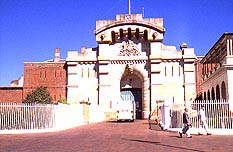
|
| Bathurst Gaol
|
Bathurst Gaol
Brooke Moore Ave joins Vittoria St and Browning St. It
contains the gaol's massive, hand-carved sandstone gate,
featuring a lion's head holding a key - a Victorian symbol
of secure and certain retribution. The gaol, designed by
James Barnet and opened in 1888, is not open for inspection.
Mt Panorama
Mt Panorama is one of the country's prime venues for touring
car racing with the Bathurst 1000 and the Australian 1000
Classic held every October. Motorcycle racing began on the
roads near the mount in 1911 and speedway racing ensued with
the Old Vale Circuit in operation from 1931 to 1937. The Mt
Panorama Circuit was established in 1938 as a scenic route
although it is likely that the idea of a motor-racing
circuit underscored the endeavour as both cycle and car
racing were transferred to Mt Panorama that same year. The
first motorcycle Grand Prix was held in 1949 and the first
car Grand Prix in 1958. The race that is now called the
Bathurst 1000 was inaugurated in 1960 with Jack Brabham an
early hero of the course. The event is now attended by some
40 000 spectators.
This 6.2-km scenic circuit is open to the public all year
round (at 60 kph), offering fine views over the area at an
elevation of 874 m. The lap record is 129.7 seconds, set by
Neil Allen in a McLaren M10B F5000 in 1970. It is located at
the south-western corner of Bathurst. Follow William St to
its western end and it branches off to the left as Panorama
Ave. The race entry begins after you cross Hawthornden
Creek.
Racing Hall of Fame
At the end of Panorama Drive you will come to Murray's
Corner where you will find the Mount Panorama Motor Racing
Hall of Fame. It is open, for a fee, from 9.00 a.m. to 4.30
p.m. daily. There are race-winning motorcycles and cars, a
photographic collection, a non-stop video covering racing on
Mt Panorama since 1963, along with trophies, helmets and
other memorabilia with sales of videos and souvenirs, tel:
(02) 6332 1872.
Mount Panorama Winery
Turn right at Murray's Corner into Pit Straight, travel
across the starting grid and turn left into Mountain
Straight. At no.117 is Mt Panorama Winery, established in
1991. It is closed on Mondays, tel: (02) 6331 5368.
McPhillamy Park
At the southern end of the circuit is McPhillamy Park.
Situated atop Mt Panorama it provides fine views over
Bathurst and the surrounding farms. The lookout is best
visited at sunrise and sunset.
Bathurst Goldfields
As you come down from the summit through the 'S' bends and
around Forrest Elbow you will see the entrance to Bathurst
Goldfields, a reconstruction of a goldmining village which
has a mine, a working stamper battery crushing ore,
operative steam engines, a miner's hut, a blacksmith's forge
and gold panning lessons. A visit takes the form of a guided
tour and there are exhibits and accommodation available.
Tour times are obtainable from the Bathurst Visitors' Centre
(tel: 02 6332 1444) or you can ring Bathurst Goldfields on
(02) 6332 2022. The address is 428 Conrod Straight.
The Slattery Museum
At the southern end of Bentinck St is St Stanislaus College,
a fine three-storey Gothic structure which was built in
1873. The oldest Catholic boarding school in Australia, it
is constructed of decorative red brick with two towers,
scalloped bargeboards, marble fireplaces and pine and cedar
joinery. The fine marble hall was designed by Edward Gell.
It was at the college, in 1896, that Australia's first
X-ray was taken in 1896 by Father Slattery and the museum
within is dedicated to Slattery who was at the forefront of
numerous scientific developments. It is open, for a fee, by
appointment only, tel: (02) 6331 4177.
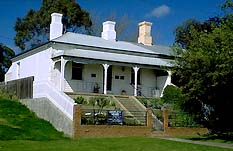
|
| Ben Chifley's house in
Bathurst |
Chifley Home
The modest house which prime minister Ben Chifley
(1885-1951) shared with his wife from 1945-1949 is open
Saturday to Monday from 11.00 a.m. to 3.00 p.m.. It is
located at 10 Busby St, tel: (02) 6332 1444.
Showgrounds
Kendall Ave (part of the highway) will take you from Durham
St across the Evans Bridge over the Macquarie River. It is
the access point to the showgrounds where you will find the
very unusual timber showground pavilions (c.1880), built in
the style known as 'Carpenter's Gothic'. The two-storey
brick gatehouse is also of interest.
Cobb & Co Heritage Trail
The historic inland coaching company, Cobb & Co, celebrates
the 150th anniversary of its first journey in 2004 (and the
80th anniversary of its last, owing to the emergence of
motorised transport). The trailblazing company's
contribution to Australia's development is celebrated with
the establishment of a heritage trail which explores the
terrain covered on one of its old routes: between Bathurst
and Bourke.
Cobb & Co's origins lay in the growing human traffic
prompted by the goldrushes of the early 1850s. Bathurst was
central, in that it became the site of the company's
headquarters in 1862, under the management of local boy,
James Rutherford. The first coach arrived at Bathurst, from
Victoria, to the applause of a large fanfare, and with
Rutherford at the reins. The company's principal coach
construction factory operated behind Bathurst's Black Bull
Inn until 1881 (now part of the Bathurst Shopping Centre, at
the corner of Bentinck and Howick Sts.
As the Heritage Trail website states: 'The company was
enormously successful and had branches or franchises
throughout much of Australia, New Zealand, South Africa and
Japan. At its peak, Cobb & Co operated along a network of
tracks that extended further than those of any other coach
system in the world its coaches travelled 28,000 miles
(44,800km) per week and 6000 (out of their 30,000) horses
were harnessed every day. Cobb & Co created a web of tracks
from Normanton on the Gulf of Carpentaria and Port Douglas
on the Coral Sea down to the furthest reaches of Victoria
and South Australia in all, a continuous line of 2000
miles (3200km) of track over eastern Australia from south to
north, with a total of 7000 miles (11,200km) of regular
routes' (see www.cobbandco.net.au)
The Bathurst leg of the trail takes in the aforementioned
Black Bull Inn, the site of the town's second coach factory,
the original passenger pick-up site, the original booking
office site, the Anglican Cathedral, which has a memorial to
Rutherford, his first home, the mansion he later built, the
cemetery where he lies, and the Visitors Centre, which has a
related booklet, a restored Cobb & Co coach, and the book
'The Cobb & Co Trail From Bathurst to Bourke.' The trail
also takes in related sites around the shire.
Kelso
On the other side of the bridge is Kelso which was
established soon after 1815 when Governor Macquarie granted
ten 50-acre allotments to ten settlers on the east side of
the Macquarie River. At the Gilmour St intersection is the
post office group which serves as a reminder of the colonial
period. The post office, butcher's shop (a former inn) and
the Kelso Hotel are of stuccoed brick with original 12-pane
windows. They are thought to date from the 1840s while the
general store, a rare survivor of its type, dates from 1890.
Another early inn now forms the basis of the Evans Shire
Chambers just down Lee St.
Woolstone
Turn left into Gilmour St. To the immediate left is the
magnificent building known as 'Woolstone' which was built in
the 1890s by the son of Thomas Kite, one of the first ten
settlers. This building was superimposed upon Thomas Kite's
earlier cottage (c.1840).
The Holy Trinity Church
A little further along Gilmour St is Holy Trinity Church -
the first church to be built in inland Australia and the
first Anglican church in the country to be consecrated (by
Bishop Broughton, the first Anglican bishop). The Anglican
parish of Kelso was founded in 1825.
The church is situated on a hill overlooking Bathurst and
is surrounded by a pioneer cemetery. The parish hall at the
foot of the hill is older and once housed the first school
in the district.
The two-storey Gothic rectory was designed by Edmund
Blacket and built in the 1870s. The church is open from 1.30
p.m. to 4.00 p.m. on Sundays and at other times by
appointment, tel: (02) 6332 4606.
Bathurst Sheep and Cattle Drome
If you turn off the highway at Kelso into Boyd St it becomes
Limekilns Rd. After 6 km take the signposted right into
Bathurst Sheep and Cattle Drome. This property housed an
army camp in World War II and then a migrant hostel.
The 'Drome' is intended to furnish some insight into
aspects of life on the farm for those who are unacquainted.
It is popular with children, school groups and particularly
Japanese visitors. Sheep and cattle are paraded on a stage
to a commentary (in English and Japanese) on the different
breeds and their uses. There are boomerang and
spear-throwing, sheep-shearing, wool-classing, lamb-feeding
and sheep-dog demonstrations with an emphasis on audience
participation, as well as pony rides, an animal nursery and
farmyard (with emus), a small golf-range and dorm-style
accommodation. Performances are held at 11.00 a.m. daily
with extra shows in the school holidays, tel: (02) 6337
3634.
Ben Chifley Dam
Ben Chifley Dam is 19 km south-east of Bathurst via The
Lagoon. Power boating, sailing and fishing can all be
enjoyed but no swimming is allowed.

Broadwalk
Business Brokers
Broadwalk Business
Brokers specialise in General Businesses for Sale, Caravan Parks for
Sale, Motels for Sale, Management Rights & Resorts for Sale, Farms for
Sale, Hotels for sale,Commercial & Industrial Properties for Sale.
Phone:
1300 136 559
Email:
enquiries@broadwalkbusinessbrokers.com.au
AUSTRALIAN BUSINESSES FOR SALE
COFFS HARBOUR BUSINESS BROKERS
BROADWALK BUSINESS BROKERS
GOLD COAST BUSINESSES FOR SALE
BRISBANE BUSINESSES FOR SALE
SYDNEY BUSINESSES FOR SALE
CARAVAN PARKS FOR SALE
BUSINESSES FOR SALE
MOTELS
FOR SALE
HOTELS
FOR SALE
Disclaimer
We advise prospective purchasers that we take no
responsibility for the accuracy of any information in the business
provided by vendors or their professional advisers and that they should
make their own enquiries as to the accuracy of this information,
including obtaining independent legal and/or accounting advice
Bathurst