|
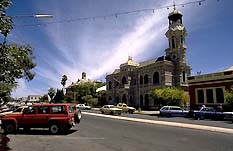
| The main street of Broken
Hill |
Broken Hill (including Mootwingee National Park)
Major outback centre of New South Wales and famous mining
town.
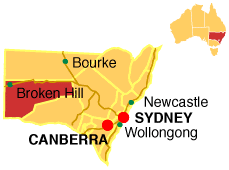
Broken Hill is located on the Barrier Range in the far west
of NSW, just 48 km east of the South Australian border. 1160
km west of Sydney via the Great Western, Mitchell and
Barrier Highways and 304 m above sea-level it had a
population in 1991 of 23 263.
'The Silver City', as it is sometimes called, is and
always has been inextricably associated with the silver,
lead and zinc mining. Many of the streets are named after
metals, minerals and compounds, or after mine managers,
leading citizens and civic leaders. The town is also the
centre of the 16-million hectare West Darling pastoral
industry which has 1.75 million wool-producing merino sheep,
protected by a 600-km dog-proof fence.
One of the most striking aspects of the town, apart from
the number of pubs, is the remarkable aridity of the region.
Drive out to the start of the Mundi Mundi Plain,
north-west of the town, and marvel at the fact that you are
in New South Wales and the desert around you doesn't
fundamentally change until you reach the coast of Western
Australia. Broken Hill is literally an oasis in the desert,
a place of green parks and gardens. It can get very hot in
summer but it is rare for the daily maximum to exceed 38° C
for more than 8 or 9 days a year.
History
The earliest known human inhabitants of the area are said to
be the Willyama Aborigines, although, with no permanent
water supply in the area their presence was only
intermittent. With the arrival of Europeans they were
decimated by disease and forcibly driven from the lands.
More recently the Paarkinji people have moved up from the
lower Darling.
The first Europeans to see the Barrier Range were Charles
Sturt and party in 1844. Sturt was trying to determine the
existence of an inland sea. Sturt referred to a 'broken
hill' in his diary. He also named the Barrier Range as a
result of the difficulties it presented to his progress.
Sturt described the land as some of the most barren and
desolate he had seen.
During their trek of 1860-61 Burke and Wills passed
through the area. They formed a base camp at Menindee to the
south-east and stopped at Mootwingie to the north-east.
Pastoralists, who had followed in the wake of Sturt in
the 1850s, moved further west in the 1860s. Much local land
was taken up in 1864. Goods were shipped up the Darling via
river steamer and then hauled overland by bullock teams.
Mount Gipps station was taken up around 1863. By 1867
there were gold prospectors in the area. However, it wasn't
until 1883, after the discovery of silver in the area, that
Charles Rasp, a watchful boundary rider at the Mt Gipps
station, discovered what he thought were tin deposits at the
'broken hill'. The samples he took contained silver chloride
and he claimed 16 hectares.
A syndicate of seven was set up with the object of
purchasing the surrounding land to prevent a rush from other
miners. In January 1885 they hit a rich vein of silver in
what turned out to be one of the world's largest known
silver-lead-zinc lodes. They made vast fortunes, although
two members of the syndicate were unfortunate enough to sell
their shares for a pittance before the scale of the find was
apparent.
|
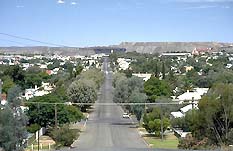
| View over Broken Hill
from the top of Chloride Street - the mine can be
seen behind the town |
The ore body was a continuous arch 7 km long and 220 m
wide. Later that year they decided to form and float shares
in The Broken Hill Proprietary Company (BHP), now
Australia's largest company.
A stone chimney and plaque in Proprietary Square, by the
skimp dump, marks the spot of the hut which was built at the
foot of the hill for the use of the first miners. It was
later used as a BHP works office.
As the effective founder of BHP, one of Australia's most
important companies, Rasp is a significant figure in
Australian history. However, according to his biographer, he
was not at all the simple lucky man he appeared. 'Rasp' was
in fact born in Saxony as Hieronymous Salvator Lopez von
Pereira. His grandfather was of the Portuguese aristocracy.
His father became private secretary to a German prince,
moved to Saxony, married a German woman and died while being
pursued by the financier Rothschild. Both men sought to
obscure their identity by changing the family name.
'Jerome', as Rasp was then known, received an education in
economics in the Baltic States. He later joined the army
and, for complicated reasons, decided to abandon the army
and head for Australia while fighting in the Franco-Prussian
War.
Soon after mining commenced the township was surveyed.
Randolph Bedford wrote that 'Argent St was a huge dust heap,
filled with hotels and flimsy offices and saloons. A two
chain wide road knee deep in dust, and crowded with men from
all the earth, selling at tremendous prices shares in
alleged mines'.
Broken Hill was declared a municipality as early as 1888
and a city in 1907.
The geographic isolation of the town was originally an
added expense to the mine's transport costs. The South
Australian government extended their line to the border but
the NSW government refused to join it to the two nearby
towns so the locals formed the Silverton Tramway Company
and, in 1888, built a line to the South Australian border.
It soon became the most prosperous private railway in
Australia. A line from Sydney arrived in 1927. The two
tracks were of different gauges and a transcontinental line
from Sydney to Perth was not opened until 1970.
Smelting was initially carried out on the site from 1886
but was transferred to Port Pirie, South Australia, when its
smelter came into operation in 1898. At first there was no
known way to extract the zinc from the ore in a
cost-effective manner. It was Herbert Hoover, later
president of the United States, who first succeeded in this
endeavour when he formed the Zinc Corporation in 1905.
Working, housing and living conditions at Broken Hill
were appalling in the early days as the population soared
from virtually nil in 1886 to 20 000 in 1891. Dysentery and
diseases like typhoid were a problem due to the unsanitary
conditions and lead poisoning was rife. 360 men were killed
in the mines between 1894 and 1913, with many more dying
subsequently of lung disease. BHP employees even had to pay
the company four shillings out of their first pay for the
shovel they were to use.
Not surprisingly industrial unrest emerged and Broken
Hill developed a strong trade union movement which pressed
for improvements. Industrial disputes were particularly
common in the 1890s. A strike in 1892 to protest the usage
of scab labour saw union leaders imprisoned. Unrest peaked
again from 1909-1921 with the 'Big Strike' occurring in
1920.
The Barrier Industrial Council, an affiliation of
eighteen unions, was formed in 1923. The amalgamation proved
highly successful in resolving disputes with the Mining
Managers' Association through arbitration. Both working
conditions and industrial relations greatly improved. The
trades hall (built 1898-1905) was the first building in
Australia owned by unions. Its original foundation stone was
laid in 1891 by Sir Henry Parkes but strike action swallowed
all available funds and building did not commence until
1898, by which time the original stone was gone. In the same
year The Barrier Daily Truth became a rare example of a
newspaper wholly owned and controlled by unionists.
Broken Hill became the first town in the state to get a
motorised mail service (1911), although initial confidence
was not high. A horse-drawn vehicle followed the truck from
Menindee in case it broke down.
On New Year's Day, 1915, Broken Hill became the site of
the only outbreak of war hostilities on Australian soil. It
began when a trainload of picnickers passed an ice-cream
cart flying the Turkish flag at the eastern fringe of the
town. Two men fired at the picnickers killing three people
and wounding another six - a boy, a girl, three women and an
old man. The two gunmen were locals of Turkish origin. They
moved on to a cottage where they murdered the occupant and
then were confronted by a party of police, soldiers and
rifle-club members. After a lengthy battle the men were
killed. Today there is a railway truck to mark the spot of
the initial encounter (listed on the town's heritage trail)
and a replica ice-cream cart at White Rocks, at the northern
end of the town, where the shootout occurred.
Dust storms plagued Broken Hill in the early days. Today
the encroaching sand is kept at bay by a protective reserve
which completely surrounds the town, established in 1936-37
at the suggestion of local naturalist Albert Morris.
Water supply, always a problem in the past, was resolved
in 1952 when a 109-km pipeline was built to channel water to
Broken Hill from the Menindee Lakes.
BHP ceased work at Broken Hill in 1940. Today Pasminco is
the only remaining operator, formed through a merger of
companies in 1988. The ore is now mined, extracted, brought
to the surface and treated to separate the valuable minerals
from the waste rock. The resulting concentrates are still
being smelted at Port Pirie.
Famous Residents
Broken Hill and district has also been the birthplace or
home of a number of historical figures. Australian soprano
June Gough was born at Broken Hill in 1929, taking the stage
name June Bronhill in honour of her birthplace. Noted artist
Pro Hart was born here the year before and has remained in
the town.
In an earlier era two sons of Charles Dickens were
associated with local sheep stations: Alfred managed Corona
to the north from 1869-72 and Edward managed Mt Murchison
station (see entry on
Wilcannia) .
C.J. Dennis lived and worked here just after the turn of
the century, subsequently writing 'A Ballad of the Barrier'.
Kenneth Cook is thought to have used it as the model for his
inland city of Bundanyabba in the novel Wake in Fright
(1961). The film was shot at nearby Silverton.
Things to see:
Historic Buildings
The visitor's centre has a map and pamphlet to accompany a
signposted heritage walking tour which takes in the many
outstanding heritage buildings which have been listed by the
National Trust. A book is also for sale ($8.50) which
outlines an expanded version of the walking tour and
includes an even more extensive driving tour called The
Silver Trail which is an informative account of the relevant
sites and their relationship to the town's history.
Most of the notable buildings are in Argent St. At the
corner with Chloride St is the red-brick Post Office
(1890-92), designed by James Barnet, with its massive turret
capped by a decorative mansard roof and enveloped by a
footpath verandah and corner balcony. Next door is the
town's architectural highlight, the extraordinarily ornate
Town Hall (1890-91). Next to it is the modest Police station
(1890). It replaced an earlier tin shed in which the
prisoners were chained to the flooring joists, although if a
female prisoner was present they were chained to the station
fence outside!
Next door is the Federation-style Technical College
(1900-01) with its large, arched windows and ornamented
entrance. Built to meet the needs of the mining industry it
now also houses a museum. Adjacent is the dignified and
unpretentious Courthouse (1889), again designed by James
Barnet. In the grounds is a sculptured bronze war memorial
made by noted artist Charles Webb who died one week before
its unveiling in 1925.
|
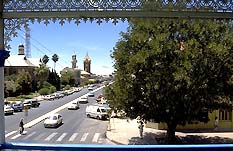
| Looking down the main
street from the balcony of the Palace Hotel
|
There are also a number of historic hotels. The most
impressive of these is the large, three-storey Palace Hotel
(1889) with its lengthy verandahs and elaborate cast-iron
balustrades. It was used in the movie Priscilla, Queen of
the Desert.
Other notable buildings include the highly ornate facade,
stained-glass windows and geometrically patterned ceiling of
the Trades Hall (1898-1905), Mt St Joseph's Convent of Mercy
(1891), the Sacred Heart Roman Catholic Cathedral (1903) and
the impressive interior of the Gothic revival Wesley Church
(1888), all in Sulphide St.
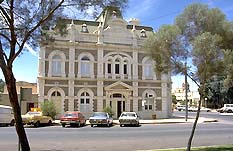
|
| Trades Hall
|
The old sandstone railway station, at the corner of
Blende and Bromide Streets, diagonally opposite the Tourist
Information Centre, was built by the Silverton Tramway
Company to replace the original iron and timber station
(1888). The building is largely unaltered and has an
attractive interior. Closed in 1970 it is now the Railway,
Mineral and Train Museum, open 10.00 - 3.00 daily, with a
display of old locomotives, railway machinery and a large
mineral collection. There is a separate hospital museum.
Broken Hill is also the site of Australia's first mosque.
It was erected in 1891 by a small group of Muslim camel
drivers from Afghanistan and India. The location is the site
of a former camel camp. Importation of the animals had
commenced in 1840 and the first Afghan camel driver, Dost
Mahomet, accompanied Burke and Wills in 1860. He is buried
near Menindee (see entry on Menindee). Now restored it is
located at the corner of Buck and William Sts and is
available for inspections on Sundays at 2.30, tel: (08) 8088
6060.
Parks, Museums and Galleries
Sturt Park is an attractive place to stop for lunch. The
reserve features The Titanic Memorial, in memory of the
bandsmen of the Titanic who kept playing in the hope of
maintaining calm while the ship went down in 1912. The
broken column is not an unrepaired accident but an ancient
Greek symbol of being cut down in youth.
Riddiford Arboretum in Galena St between Pell and Mercury
Sts features Broken Hill's (and South Australia's) floral
emblem, the stunning Sturt's Desert Pea. It was named after
Charles Sturt who gathered specimens around present-day
Broken Hill in 1844.
The Albert Kersten Geocentre, located in the old Bond
Store building (1893) on the corner of Crystal and Bromide
Sts, has displays on the geological history of the earth,
the history of the town and its mines, a large mineral
collection, treasure maps and treasure trails for the
children and souvenirs. It is open from 1-5 daily.
White's Mineral Art and Mining Museum is located at 1
Allendale St, west of town off Silverton Rd. It features a
walk-in mining stope (an excavation site), collages made of
crushed minerals depicting mining equipment, local
historical buildings and landscapes, and the legend of
Sturt's desert pea. There is also a mining video, guided
tours, salvaged machinery, scaled models of mine structures
and displays of mineral specimens, jewellery, dolls, opals
and pottery. It is open 9-6 daily, tel: (08) 8087 2878.
The Conservation Centre in Crystal St is a museum of
antiquated machinery run by volunteers. It is only open on
Sunday afternoons, tel: (08) 8087 4559.
Broken Hill has also become an important regional art
centre. It is home to the so-called 'Brushmen of the Bush',
a group consisting of Pro Hart, Eric Minchin, Hugh Schulz,
John W. Pickup and Jack Absalom. Although diverse of style
they are all self-taught and are all noted for their
distinctly Australian subject matter and the inspiration
they draw from the town and its surrounds.
There are numerous galleries in town featuring local,
national and international works. A complete list can be
found at the visitor's centre or in the telephone book. The
City Art Gallery, in the civic centre at the corner of
Blende and Chloride Sts, is the second oldest art gallery in
Australia after the State Gallery of NSW in Sydney. It
started in 1904 when George McCulloch donated some
paintings. The display features traditional, modern and
Aboriginal works and includes the 'Silver Tree',
commissioned by Charles Rasp. It is open seven days a week
(08-8088 5491).
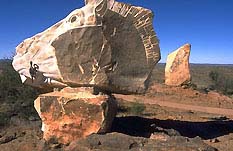
|
| Wilcannia stone sculpture
on the edge of the desert |
The City Gallery has a pamphlet (also available from the
visitor's centre) relating to the Living Desert Art Trail
which takes you on a walk through the Living Desert Reserve,
located on the northern outskirts of town along Nine Mile
Road. Its 2400 hectares contain aboriginal sites, a
regeneration reserve, panoramic views, a four-wheel drive
track, a permaculture site, a range of flora and fauna and
there are currently plans to set up an animal reserve for
endangered species. In 1993 twelve international sculptors
each worked on a huge Wilcannia sandstone boulder of their
own without power tools for 14 hours a day, every day for 8
weeks. The results are still there for all to see. A book
about the sculptures is available at the visitors' centre.
16 artists from around the world were also invited to the
site to paint the landscape as they saw it from a given
position. The results hang in the City Gallery but poles now
mark the spots where each artist stood and the pamphlet
allows you to compare the painted image with your own
perspective from that spot.
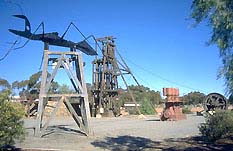
|
| Pro Hart's giant ant
sculpture in Rotary Park |
The Pro Hart Gallery features a collection of Australian
and European works and one of the largest pipe organs in
Australia. At 108 Wyman St it is open 9-5 weekdays and
Sunday afternoons, tel: (08) 8087 2441.
Jack Absalom's Gallery is at 638 Chapple St (08) 8087
5881, Hugh Schulz's can be found at 51 Morgan St (08) 8087
6624, and Eric and Roxanne Minchin's is located at 105
Morgan St (08) 8087 5853.
The largest commercial gallery in town is the Ant Hill
Gallery at 24 Bromide St, opposite the visitor's centre (08)
8087 2441. Also worth a look is D'Art De Main Galleries at
233 Rowe St (08) 8087 6308. The latter is situated in a
heritage building surrounded by beautifully landscaped
gardens.
Thankakali Aboriginal Arts and Crafts Centre
Located on the eastern edge of town the Thankakali
Aboriginal Arts and Crafts Centre is particularly
interesting and worth visiting. It is located in the old
South Australian Brewing Company building (which has some
huge spaces). The visitor enters and it taken through a
series of well-presented art galleries with the lights
automatically coming on as the visitor enters each new room.
Perhaps the most interesting aspect of the gallery is that
it does not adhere to the current dot painting orthodoxy.
Mercifully there is also no sense of overt commercialism in
the gallery. Instead there is a wide variety of styles and
artistic forms (didgeridoos, song sticks, linocut prints) on
exhibition. All the paintings are for sale and range in
price from a few hundred dollars to $3,500. There is also a
café and the people who run the gallery are happy to talk to
visitors.
In the Area
1. Delprats Underground Tourist Mine
The town's mining history can be experienced first-hand at
Delprats Underground Tourist Mine. This 2-hr tour will take
you deep inside one of BHP's old mines in a cage with
miner's hat and light. The site is five minutes drive from
the visitor's centre. Head south on Iodine St and, once
across the railway tracks, turn right following the signs.
Tours are held at 10.30 am weekdays and at 2 pm on Saturdays
(08) 8088 1604. Be sure to arrive 15 minutes before
commencement.
2. Day Dream Mine
One of the original mines around Silverton is the Day Dream
Mine, which opened in 1882. It is located 33 km to the
north-west. Take the Silverton Rd out of town and, after 20
km, watch for the signposted turnoff to the north. The tour
takes one hour. You can either make a booking at the
visitor's centre or just turn up any time between 10 and
3.30 seven days a week.
3. Royal Flying Doctor Service and School of the Air
The Royal Flying Doctor Service has its headquarters at
Broken Hill and is interconnected with the School of the
Air. Inspections can be made to see both if you make a
booking at the visitor's centre. The former has a film about
the service, a museum and a visitor's shop.
4. Joe Keenan's Lookout
There is a fine view of the town and the mine dumps plus
information boards on the town's history at Joe Keenan's
Lookout in Marks St.
5. Stephen's Creek Reservoir
17 km north-east of town is Stephen's Creek Reservoir.
Constructed in 1892 it holds 20 000 megalitres and is an
ideal picnic spot. Another such location is the Twin Lakes
on the northern side of Wentworth Rd in South Broken Hill.
6. Mootwingee National Park
130 km to the north-east is Mootwingee National Park,
located on a rocky, cypress pine and mulga-clad
red-sandstone range. Wildlife includes falcons and
wedge-tailed eagles, euros, skinks, frogs, snakes, emus,
kangaroos and lizards. The insect eating sundew plant can
also be found amongst the flora.
There are numerous self-guided walks of varying length
and difficulty through shaded gullies, open ridges, dry
sandy creek beds, historic Aboriginal and European sites,
pleasant rock pools and some truly splendid scenery. Sunsets
are particularly impressive. The walks are outlined in
pamphlets available at the park's visitor's centre (13 km
east off the Tibooburra Road) or through the National Parks
and Wildlife Service (NPWS) Office, located at 183 Argent
St, Broken Hill, tel: (08) 8088 5933.
The park's 5-million-year-old quartzite and sandstone
gorges have acted aswater catchments and have provided a
reliable source of water. Consequently the reserve contains
Aboriginal material dating back some 40 000 years, including
paintings, stone arrangements and other artefacts. There are
several large rock shelters, one extending for 21 metres x
2.7 metres, which are adorned with a range of artwork both
figurative and abstract. Parts of the park were handed back
to the traditional owners in 1991.
Mootwingee Historic Site has some particularly impressive
rock engravings and ochre stencils (created by blowing
mouthfuls of pigment over a hand), together with explication
of relevant aspects of Aboriginal mythology. Access to this
site is only by guided tour (2.5 hours) on Wednesday and
Saturday mornings from April to November at 11 am. Bookings
are essential. Phone the NPWS office. There is a small fee
associated with this tour which also takes in the Mootwingee
Cultural Resource Centre. Alternatively you can follow the
self-guided Homestead Creek Track which also takes in
significant Aboriginal sites.
A section of the park was originally part of Mootwingee
Station and there are remnants from the pastoral era. The
Old Coach Road Drive (10 km) takes in the ruins of Rockholes
Hotel, Gnalta Lookout and some amazing rock formations. The
Thaaklatjika Mingkana Walk includes Wright's Cave, named
after William Wright, one-time manager of Kinchega Station,
who was hired as part of the Burke and Wills expedition at
Menindee because of his knowledge of the local area. He was
widely blamed for the tragedy that befell the expedition
when he failed to meet the party as arranged at Cooper
Creek. The cave contains Aboriginal artwork as well as a
blue triangle painted by Wright with his initials inside.
The park is 2 hours drive from Broken Hill on the Silver
City Highway to Tibooburra. Bring plenty of fuel, good
walking shoes, extra provisions in case rain blocks you in,
a hat and some sun screen. Always take water on your walks
as it can get very hot indeed. There is bore water only at
the Homestead Creek campsite which has basic facilities such
as fireplaces, barbecues, toilets and showers.
If you return via Waterbag Station Rd it will take you
south to the Barrier Highway which takes you back to Broken
Hill. On the way you will pass Little Topar Pub which is a
pleasant spot for a stopover.

Broadwalk
Business Brokers
Broadwalk Business
Brokers specialise in General Businesses for Sale, Caravan Parks for
Sale, Motels for Sale, Management Rights & Resorts for Sale, Farms for
Sale, Hotels for sale,Commercial & Industrial Properties for Sale.
Phone:
1300 136 559
Email:
enquiries@broadwalkbusinessbrokers.com.au
AUSTRALIAN BUSINESSES FOR SALE
COFFS HARBOUR BUSINESS BROKERS
BROADWALK BUSINESS BROKERS
GOLD COAST BUSINESSES FOR SALE
BRISBANE BUSINESSES FOR SALE
SYDNEY BUSINESSES FOR SALE
CARAVAN PARKS FOR SALE
BUSINESSES FOR SALE
MOTELS
FOR SALE
HOTELS
FOR SALE
Disclaimer
We advise prospective purchasers that we take no
responsibility for the accuracy of any information in the business
provided by vendors or their professional advisers and that they should
make their own enquiries as to the accuracy of this information,
including obtaining independent legal and/or accounting advice
Broken Hill