|
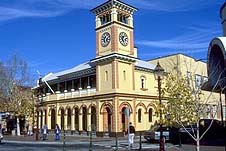
| Maitland Post Office
(1881) |
Maitland (including Woodville)
Major city in the heart of the Hunter Valley
Maitland, located 163 km north of Sydney and 32 km
north-west of Newcastle, is situated just 10 m above
sea-level on flood plains adjacent the Hunter River.
Consequently it has had 15 major floods during the era of
European settlement (the first being recorded in 1819). The
last was in 1955 when 11 were killed, prompting the
construction of levies, spillways and flood channels to
mitigate the effects. So prominent have floods been to the
city's history that there is a major artistic presentation
in the grounds of the Maitland Visitors' Centre.
Despite this proximity, the river has, unfortunately, not
been thoughtfully incorporated into the townscape. The
buildings which line High St, historic and attractive as
many are, seem to hide the beauty of the river. Only the
ideally located Chives Riverside Cafe, situated down a short
alleyway which runs off the High St mall, makes use of the
town's scenic potential by placing its seating under the
shade of a large tree by the river.
Maitland was once the principal town of the Hunter Valley
and consequently it has many historic buildings of
considerable quality. Today, a local brickworks, light
industry, tourism and an open-cut mine are the economic
mainstays. Many residents now commute to the mines further
north up the Hunter Valley and south to the Newcastle area.
The Gringgai clan of the Wanaruah Aboriginal people
occupied the area prior to white settlement, calling it
Boe-oon after a species of waterfowl. The Wanaruah had trade
and ceremonial links with the Kamilaroi people. They
favoured goannas as a food source, covering larger animals
in hot ashes and stuffing them with grass. They also adopted
burning off practices as the new shoots which emerged after
fire attracted kangaroos which they surrounded and killed
with clubs and spears (du-rane) barbed with sharp stones.
They also used stone axes (mogo) made of hard volcanic rock
bound to a wooden handle.
Lieutenant-Colonel Paterson of the NSW Corps explored the
Hunter in 1801 and named the site of the future town
Schanck's Forest Plains. Cedar-getters soon followed,
calling it 'The Camp. Permanent European settlement
commenced when Governor Macquarie opened the Lower Hunter up
in the years 1818 to 1821. Eleven emancipated convicts were
granted small plots of land as a reward for good behaviour
and free settlers began to move in to what was renamed
'Wallis Plains' after the commandant of Newcastle.
The locals called the settlement Morgan's Plains after
one of the earliest and best known of the convict settlers -
Molly Morgan. In 1814, she was sentenced to a further seven
years for the theft of some government cows and was sent to
the harsh penal settlement for re-offenders at Newcastle.
However, then in her fifties, she became the mistress of an
official and around 1819, received 159 acres at Wallis
Plains, that land constituting what is now the business
district of Maitland. She opened Wallis Plains' first
licensed establishment (a grog shanty) and extended her
holdings.
Development was fostered by a bridge over Wallis Creek in
1827 and a road from Windsor in 1831. A government town had
been planned by 1829 and substantial administrative
buildings were erected. The government town was proclaimed
as Maitland in 1833. When the other settlement became known
as West Maitland in 1834 confusion arose. As a result the
boundaries were clarified and the names East Maitland and
West Maitland were adopted in 1835. The combined population
the following year was 1163. The three neighbouring villages
became an important focus of the river trade with a regular
river steamer service operating along the Lower Hunter to
Newcastle. Caroline Chisholm founded one of her Female
Emigrants' Homes at East Maitland in 1842. The Maitland
Mercury was established in 1843, making it one of the oldest
surviving Australian newspapers.
Despite floods and a superior town plan West Maitland
continued to outgrow the official settlement. Thus, in 1866,
the West had 5694 people compared to about 2000 in the East.
The former became the commercial centre and the latter the
seat of administration.
Coal mining, which commenced around West Maitland in the
1870s, became increasingly important to the local economy.
At one time 10 000 men were employed in the Maitland
coalfields with over 5 million tons being produced in 1925
alone. It is believed that the first speedway race in the
world was held at the local agricultural show that same
year.
Declared municipalities in 1862-63 East and West
Maitland, along with Morpeth, were merged as the City of
Maitland in 1944. The postwar years saw an influx of
migrants, particularly Poles, bringing new traditions and
skills to the local community.
Things to see:
![[Top of page]](smlArrow.gif)
Tourist Information Centre
The Visitors' Information Centre at Maitland is located in
Ministers Park at the corner of High Street and Les Darcy
Drive (the New England Highway), tel: (02) 4931 2800. Look
for the old steam train out the front and the 15 telegraph
poles adjacent. Each reflects upon one of the 15 major
floods which have wreaked havoc upon Maitland.
A series of display boards contain explanatory text
relating to various aspects of the town's heritage. There
are also a series of booklets detailing the heritage
buildings of the area - covering (a) Maitland (Central
Precinct) (b) Maitland (Eastern Precinct) (c) East Maitland
and (d) Morpeth.
Courthouse
At the corner of High St and Sempill St is the town's
elegant Victorian courthouse and police station, built of
dressed sandstone with a large clock tower topped by a
copper-clad dome and a fine courtyard. It was designed by
W.L. Vernon (then the first NSW Government Architect) and
completed in 1895.
Walka Waterworks Complex
Turn right into Sempill St which heads north as Oakhampton
Rd. After about 3 km turn left into Scobies Lane which leads
to the Walka Waterworks complex. One of the largest and most
intact 19th-century industrial complexes in the Hunter
Valley, it was classified by the National Trust in 1976 and
restored and reopened in the 1980s. Far more attractive than
a modern equivalent, its distinguishing features are the
fine Italianate architecture and ornate brickwork of the
pumphouse, the striking chimney, the large storage area, the
old sandstone wall enclosing the sizeable reservoir, which
is full of waterbirds, and the working model of the original
pump which is on display inside the main pumphouse.
The complex is open seven days from 7.00 a.m. to dusk and
serves a number of valuable purposes. It has an outdoor
museum display with an emphasis on the early days of the
waterworks and its related Victorian-era technologies. It is
a wilderness and recreation reserve with 12 km of walking
and cycling trails, plenty of birdlife for birdwatchers, as
well as camping, picnic and barbecue facilities. Mini-steam
and diesel trains operate every Sunday along a 2-km track,
the lake is used by model yacht enthusiasts, and there is
live music every Sunday afternoon (currently the emphasis is
on country music).
The Waterworks is a significant community facility which
hosts many diverse community events and entertainments, such
as vintage motorcycle and automobile displays and dancing
displays (everything from belly dancing to line dancing). A
folk music festival, held in June 2004, looks likely to
become an annual event and the site is also a major focus of
the annual Steamfest celebrations in April, which draw
around 5000 people to the complex, where they can enjoy the
mini-trains, steam boats on the reservoir, music, camel and
pony rides etc.
The cost of entry is $3 per car and everthing else is
free, except the train rides ($2 per turn) and the food
which is available from the shop. For further information
ring (02) 4932 0522, (0407) 919 851 or the Maitland Tourist
Office on (02) 4931 2800. They have their own website, which
can be found at www.walkawaterworks.org.au (email
tgscons@rivernet.com.au).
The Waterworks was constructed between 1879 and 1885 as
part of the first water supply scheme for Newcastle. The
water was pumped from Dickson's Falls on the Hunter to Walka
Lagoon using engines supplied by James Watt in England. It
was the first permanent, clean water supply and, at the
time, the largest industrial complex in the Hunter Valley.
However demand continually outstripped supply and Chichester
Dam was constructed in 1913. Walka thence became a back-up
supply and was closed in 1931. A power station operated on
the site between 1951 and 1978.
Regent St and Cintra
Regent Street is a classified urban conservation area full
of lovely old houses, the most striking of which are the
monumental mansions 'Benhome' at no.30 (now the headquarters
of the Maitland Benevolent Society) and Cintra (no. 34), a
beautiful and imposing two-storey Classical Revival house
set in spacious grounds with fine gardens. It was designed
by William Pender and built in Maitland's boom period (1880)
of rendered brick. The second wing was added in 1887, making
31 rooms now full of furnishings accumulated by the Long
family from the turn of the century.
The house has extensive and intricate cast-iron lacework
and Corinthian columns and a tower capped with cast-iron
decoration. The tall gates open onto a gravelled carriage
loop driveway which leads to gabled sandstock brick stables.
It is classified by the National Trust and, although not
open to the public, can be viewed from the roadside.
Family Hotel
The Family Hotel, at 605 High St, is the oldest hotel in
West Maitland. It was erected c.1860 as a coaching inn and
is a building of considerable character with a fine,
friendly and respectable atmosphere and inexpensive
accommodation. It is undergoing renovation by the current
owners who have also uncovered the old sandstone and brick
cellars which can be inspected and for which they have
development plans.
Aberglassyn House
Built in the early 1840s it is an outstanding two-storey
colonial sandstone mansion designed by John Verge and
situated on 12 acres overlooking a bend in the river. It has
a beautiful circular sandstone staircase with a dome
overhead, marble fireplaces, cedar joinery and vast,
vaulted, stone-flagged cellars. Located to the west of town,
in Aberglassyn Lane (off Aberglassyn Road) , it is no longer
open to the public.
West Maitland (Central Precinct)
Railway Station
Maitland Railway Station is located just past the roundabout
at the southernmost end of Church St. The line arrived at
East Maitland in 1857 amidst much hoopla and reached West
Maitland the following year. The original station was
further east. The current Italianate-style building dates
from about 1880.
Church St
The Grand Junction Hotel (1916) and 'Sherbourne', an
excellent 19th century building of Italianate design, have
finely detailed facades. By comparison, Maitland Public
School (1899) possesses a solid, austere, rational and
somewhat impersonal design.
Grossman House Museum and Brough House
Inverted mirror images of one another these two delightful
red-brick Victorian townhouses were built at the same time
(1860-61) by Samuel Owens (who named Brough House after his
wife's maiden name) and Isaac Beckett. Owens and Beckett had
established a large general business in Maitland's High St
in 1838. Both feature cedar joinery, marble fireplaces,
sandstone quoins, two-storey verandahs with Doric columns
below and, above, intricate cast-iron lacework, shuttered
windows and French doors.
Grossman House became a girls' school for some years (it
is named after the first principal) and has been restored,
filled with period furniture and opened as a museum, open
weekends from 1.30 p.m. - 4.30 p.m. or by appointment, tel:
(02) 4933 6452. There is a guided tour and a small admission
fee.
St Mary's Rectory
Over the road is St Mary's Rectory (1880-81), a fine
building with elaborate ornamentation. The detailed,
decorative Gothic Revival sandstone church was designed by
Edmund Blacket and its construction (1860-67) overseen by J.
Horbury Hunt. Note that the stone tracery is different on
each of the windows. Blacket also designed the furnishings
such as the complementary tracery panels of the pulpit and
reading desk. The bell is from Sydney's St Andrew's
Cathedral. The quite remarkable tower and spire were added
in 1885-86 and dominate the city skyline.
High Street
High Street, with its civic and commercial buildings, is
classified by the National Trust. It was originally a
bullock track around which the settlement grew in a
piecemeal and unplanned fashion. The land then belonged to
Molly Morgan.
A number of the shop facades are interesting and the
original dates and business names are still on some of the
upper storeys. Of particular interest are the interior of
Jakemans Pharmacy (no.452), and numbers 473 (built 1858),
427 (now Mather's), 395, 360 and 363 (now Pizza Haven). The
section between Bourke St and Ken Tubman Drive is
particularly strong.
At the corner of Church and High Sts is a relic from the
past, a 'Blackboy' horse hitching post from the United
States, made in the 1880s and initially erected outside the
post office in 1886. It has been on the present site since
1892.
The ANZ Bank building is one of the town's architectural
highlights. A rare colonial example of a Byzantine design it
was built in 1869 and features round-headed windows and a
two-storey arcaded verandah which bends around the corner
into Elgin St.
At the eastern end of the mall is a mosaic map set in the
paving which is based on a very old and incomplete original
in the Mitchell Library which provides a general outline of
West Maitland in its early days.
Adjacent is the post office (1881), a two-storey rendered
brick building designed by James Barnet with arcaded
verandahs and a bell-clock tower.
The very substantial Methodist (now Uniting) Church was
built in 1858 to a sober, unornamented but by no means plain
or uninteresting design, reflecting the values of the church
at that time.
The Catholic Group
Opposite, on the corner with Cathedral St, is St John's.
Built in 1922 as a Catholic Hall it became a Pro Cathedral
in 1933 but has been closed since being severely damaged by
the 1989 earthquake. Further down Cathedral St are the
imposing Italianate Bishop's residence and old St John's, a
Gothic Revival design by Mortimer Lewis. Initially a humble
church it was built between 1844 and 1846 but was extended
and upgraded to cathedral status in 1866 as the town grew.
It closed when the Pro Cathedral opened in 1933, became the
parish hall then, after the earthquake, became, once again,
the cathedral. Its most distinctive feature is the tower
capped with merlons and finials.
West Maitland (Eastern Precinct)
Presbyterian Church Group - Free Church Street
Free Church St runs parallel with Cathedral St. One of
Maitland's oldest surviving churches the Scots Presbyterian
Church was erected in the late 1840s. It is an unornamented
building of rendered brick. The Gothic leadlight windows
were added this century. The hall dates from 1927. The
two-storey brick manse, with its stone window lintels, was
built in 1850. It served as a school from 1855.
High Street Continued
The triple-storey former CBC Bank, designed by G.A.
Mansfield, is an Italianate Classical Revival building which
dates from 1887. Down Victoria St is the Masonic Lodge
(no.5), designed by local architect J.W. Pender and built in
1886-87. It has an unusual Arabic facade with ornamented
gable. Next door is the brick terrace house 'Inverness'
(1880s). Back on High St is the highly ornamental facade of
the Maitland Cultural Centre, one of Pender's most
impressive works. Just beyond it is Maitland's first
Congregational Church, built to a Victorian Gothic design
between 1854 and 1857. It became a drama theatre in 1964.
Over the road is the impressive Italianate town hall
built in 1888-90 to a symmetrical design consisting of a
central tower flanked by two wings with ornamental columns
supporting pediments over the ground-floor windows. The
'Town Hall Cafe' (c.1850), with its original facade, is
typical of the timber shops which then stood in High St.
Maitland Regional Gallery
Further down the road, at 230 High St, is the Regional
Gallery, tel: (02) 4934 9859.
Bourke St
Running southwards off High St is Bourke St which contains a
number of fine historical residences particularly between
Ken Tubman Drive and Olive St. Originally owned by the
wealthier members of the local community the best are
probably at numbers 28 (c.1870s) and 60 (c.1850).
Wallis Creek Bridge
On the western banks of Wallis Creek near the bridge are
Walli House (3 High St) and Bridge House (1 High St). Bridge
House, one of Maitland's oldest buildings, is a small
Georgian stuccoed stone-and-brick farmhouse with cedar
columns, flagged verandah, paned windows and panelled door,
built c. 1830, with the help of his wife's legacy, by
ex-convict Samuel Clift who purchased the property in 1826
and became a noted landholder. His descendants still occupy
the house. The tiny timber cottage is thought to be Clift's
original homestead. The stone rubble hut to one side was
probably the residence of the bridge's toll keeper.
Next door is Walli House (c.1850s) which was built either
as Clift's third house or for a son. It is a large
two-storey stone-and-brick building. Although the rear of
the house is in original condition, poorly chosen
alterations and additions were made in the 20th century
(notably the front pillars). The fittings are of cedar from
the banks of Wallis Creek. There are several outbuildings to
the rear of the house (servants' quarters, store and
kitchen).
East Maitland
John Smith and Caroline Chisholm
On the far side of the bridge are two buildings built by
John Smith. One of the original eleven ex-convict grantees
he became a noted local businessman. Probably the original
Black Horse Inn, the building at 46 Newcastle St is thought
to date from the 1820s. 'Englefield' is a Georgian structure
built in 1837 which became the new Black Horse Inn in the
1840s. Smith's flour mill began operations in 1844 and the
building (a timber ground storey topped by a stone second
storey) is located at 99 Newcastle St (by the corner with
Mill St).
Also in Mill St is Caroline Chisholm Cottage, built in
1840. It became an immigrants' home set up by Caroline
Chisholm in 1842. However, its medical services were so in
demand that it became a hospital until a new building was
erected for that purpose at West Maitland in 1846. The
original shingled roof still lies beneath the iron.
Melbourne Street
On the corner of Newcastle and Melbourne Sts is the Bank of
Australasia building (1882), designed by J.W. Pender to an
Italianate design with Doric columns about the doorway and
ionic pilasters to the upper floor (now Fry's Furniture
Store).
At 48 Melbourne St is the old George and Dragon Inn that
dates back to the 1830s. Now a restaurant with accommodation
for diners it is open in the evenings from Wednesday to
Sunday, tel: (02) 4933 7272. At the corner of Melbourne and
Lawes Sts is the mid-Victorian three storey Farmer Hotel,
with stables.
Gaol and Courthouse
The gaol, situated in John St, was designed by Mortimer
Lewis and completed in 1848. It consists essentially of a
pair of two-storey buildings with gatehouse, cells and outer
wall and is still in operation. This was the site of the
state's last official flogging in 1905.
No longer used for correctional purposes, the gaol now
offers guided tours, sleepovers and a venue for corporate
functions, tel: 02 4936 6610 (email
maitlandgaol@bigpond.com).
The brick-and-stone Neo-Classical courthouse opposite
looks down with authority on the township from its hilltop
position. It was built around 1860 upon a design of
Alexander Dawson. The facade of the central courtroom
features a gable with a clock in the pediment. There are two
flanking wings, an arcaded porch and terracotta roofing.
Day Street
'Roseneath', a two-storey brick building, was opened in 1845
as the Victoria Inn. It features large timber columns made
from whole logs, marble fireplaces and cedar joinery. In the
1850s it was owned by Samuel Clift's son George who
established a fine rose garden, hence its name.
Goonoobah
Turn right into King St where you will find the quite
enormous 'Goonoobah' built in 1841 for George Furber who
owned two local inns, including the George and Dragon. A
hall once ran the length of the building with about 20
adjoining rooms.
Banks Street
Banks Street's buildings include the Literary Institute
(1859), a meeting place for the local council in the 1860s,
and Eckford's Cottage (no.36) which, with its turned timber
columns, dates from 1845. It is built on the site of the
first Eckford home (1818). One of the first ex-convict
settlers in Wallis Plains, John Eckford was the son of
Newcastle's first harbour pilot.
At no. 40 is a Georgian mansion which started its life in
1857 as the Red Lion Inn on the site of an older version of
the same hotel. At Banks and Newcastle Sts is a park which
contains Hew Cottage, an old 19th-century slab hut found
under a weatherboard exterior.
The St Peter's Complex
The Lands Office first opened in St Peter's Parish Hall,
which is located a little further along Banks St. It was
built in the early 1840s of sandstock brick. A single-storey
building it has three dormer windows and a cedar ceiling in
a herringbone pattern.
It is possible to walk through the church grounds to St
Peter's Church which sits with a fine view along William St
to the courthouse in the distance. The church was designed
by Edmund Blacket in 1875 but executed and altered by his
son Cyril. A Gothic Revival church it was built in 1886 of
decorated sandstone with beautifully crafted stained-glass
windows, furniture and fittings. Highlights are the pulpit
of carved alabaster and marble (a memorial to the Eckford
family), which was imported from Italy, and the mosaic
floor. The single-storey rectory adjacent dates from 1860
with a large verandah and shuttered French windows.
Stockade Hill
A little further south along William St is Stockade Hill,
the site of the first schoolhouse (1829) which doubled as a
chapel. Nearby in Wallis St is 'Oldholme' a Georgian brick
cottage built in the mid-1830s for the town's police
magistrates, including Edward Day, a popular official
involved in the arrests of those involved in the Aboriginal
massacre at Myall Creek and of the bushranging gang of Teddy
Davis ('The Jewboy'). There is a memorial window in his
honour at St Peter's.
Bolwarra Lookout
Little attempt has been made to render this a beautiful spot
but there are sweeping views from the north over the city
and the river flats which surround it.
Bolwarra is at the western edge of the area known as
Paterson's Plains which stretched along the northern bank of
the Hunter from this point eastwards to the junction of the
Hunter and Paterson Rivers just east of Morpeth. Although a
few farmers had been allowed to undertake some farming in
the area the first permanent settlers were 12 ex-convicts
authorised in 1818 as part of the same settlement plan which
permitted the initial 11 to settle on the other side of the
river at what is now Maitland.
|
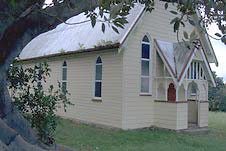
| The tiny wooden church
which stands next to All Saints at Woodville
|
All Saints Church, Woodville
All Saints Church (1863-64), an unmistakable stone rubble
building with a rustic feel adjacent a road which heads off
to Paterson. It is a small Gothic Revival church of good
quality with arched lancet windows. The porch, with its
leadlight windows, was added in 1924 after general
restoration work in 1922. The general store on the other
corner dates from the 1860s.
Woodville started its colonial existence as a land grant
to John Galt Smith in 1823. A village was in existence by
the 1850s. It grew up around the river where a punt ferried
passengers to and fro, approximately on the spot where
Dunmore Bridge now stands. The first bridge was built in
1863. A cottage once stood adjacent for the lift operator
who also had the task of sweeping the bridge in the days of
horse power.
Les Darcy Memorial
2.4 km north of the Woodville School of Arts, to the left,
is a small and ill-marked grove (keep your eyes peeled)
containing a memorial cairn to noted Australian boxer Les
Darcy who was born here. At the time his father was working
as a share farmer on what was the Stradbroke property. Darcy
attained considerable local notoriety with a remarkable
early record and was much feted in Maitland.
However the issue of service in the First World War
ruined his career. He came under considerable fire from the
Australian press and from politicians when he did not
initially volunteer. Darcy was a Catholic and the Church
opposed conscription. He left Australia for the United
States without a passport in 1916 as a conscription
referendum approached. He found himself banned from fighting
in the USA for political reasons as that country was on the
cusp of entering the war itself. He died of pneumonia in May
1917, one month after enlisting in Memphis.

Broadwalk
Business Brokers
Broadwalk Business
Brokers specialise in General Businesses for Sale, Caravan Parks for
Sale, Motels for Sale, Management Rights & Resorts for Sale, Farms for
Sale, Hotels for sale,Commercial & Industrial Properties for Sale.
Phone:
1300 136 559
Email:
enquiries@broadwalkbusinessbrokers.com.au
AUSTRALIAN BUSINESSES FOR SALE
COFFS HARBOUR BUSINESS BROKERS
BROADWALK BUSINESS BROKERS
GOLD COAST BUSINESSES FOR SALE
BRISBANE BUSINESSES FOR SALE
SYDNEY BUSINESSES FOR SALE
CARAVAN PARKS FOR SALE
BUSINESSES FOR SALE
MOTELS
FOR SALE
HOTELS
FOR SALE
Disclaimer
We advise prospective purchasers that we take no
responsibility for the accuracy of any information in the business
provided by vendors or their professional advisers and that they should
make their own enquiries as to the accuracy of this information,
including obtaining independent legal and/or accounting advice
Maitland